Epoxy flooring has emerged as a preferred solution for commercial kitchens in Orlando and across Central Florida. At GCM Best Services, we witness firsthand how these floors help businesses achieve reliable hygiene standards, safety compliance, and smooth kitchen operations. With our experience delivering high-grade epoxy and coatings, we want to walk you through why epoxy stands out for food service environments, how it relates to sanitation and safety codes, and what you need to keep in mind to stay compliant while protecting your investment.
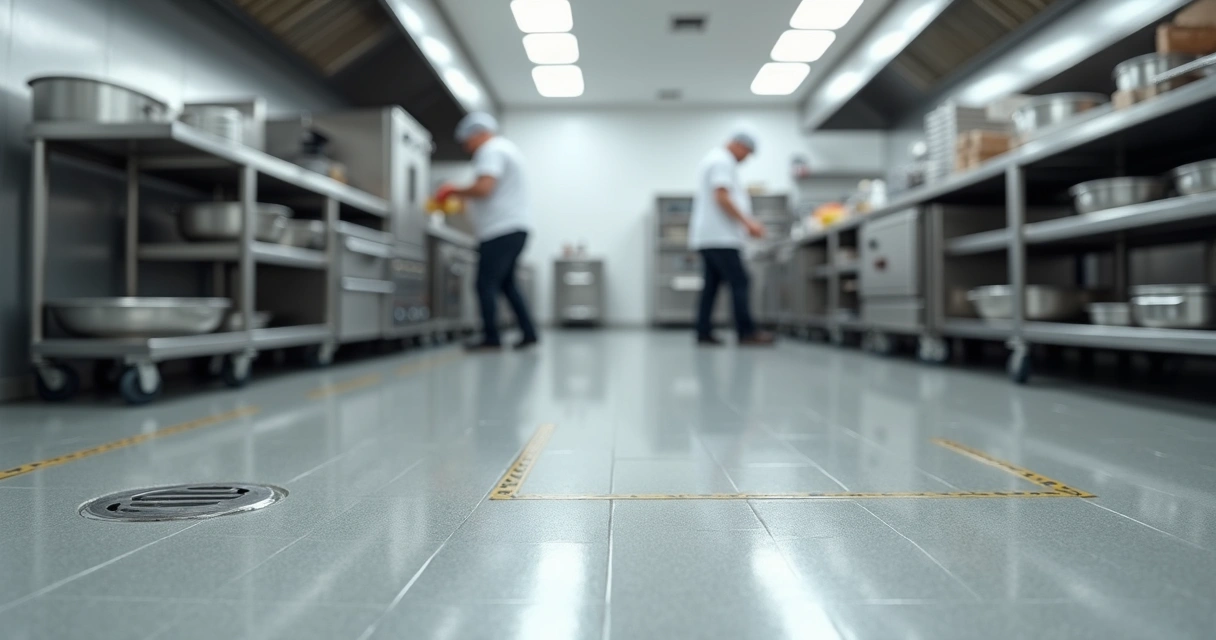
Epoxy floors lay the foundation for a cleaner, safer kitchen.
Why epoxy flooring is transforming commercial kitchens
Commercial kitchens face relentless demands: constant foot traffic, high heat, spills, heavy equipment movement, and regulatory checks. Traditional floor options can chip, trap bacteria, or require regular patching. Epoxy offers something different—a smooth, seamless surface that repels moisture and resists chemical attacks, while remaining tough under daily stress.
Our projects throughout Central Florida show epoxy excelling in restaurants, school cafeterias, hotel kitchens, bakeries, and food processing spaces. Let’s see what makes these floors so well accepted in busy kitchens:
- Seamless and non-porous: Minimizes places for food particles or bacteria to hide.
- Easy cleaning: Mops, scrubbers, and sanitizers glide over the slick surface—inhibiting cross-contamination.
- Slip resistance: Safety texture finishes help prevent falls even when floors are wet.
- High chemical resistance: Stands up to cleaning products, acids, grease, and hot liquids.
- Exceptional durability: Resists impact, scratching, scuffing, and thermal shock.
- Rapid return-to-service: Polyaspartic topcoats can be ready within hours, minimizing kitchen downtime.
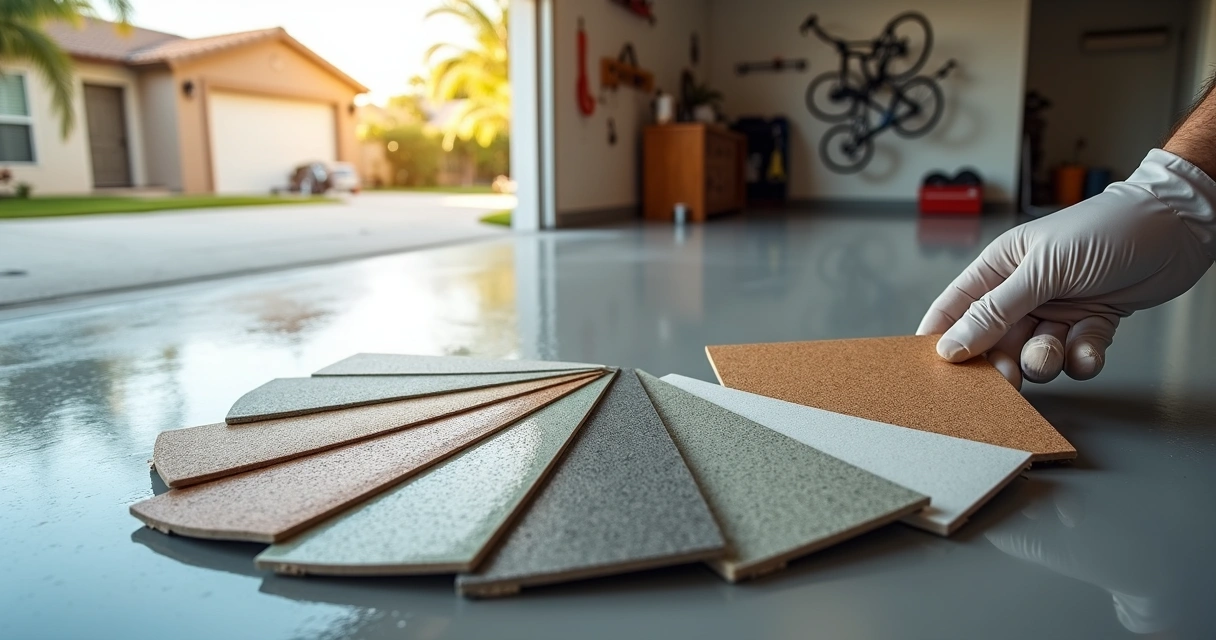
Epoxy also enables businesses to match their kitchen’s look and workflow by choosing from colors, flake broadcasts, or even integrating traffic lines and safety zones.
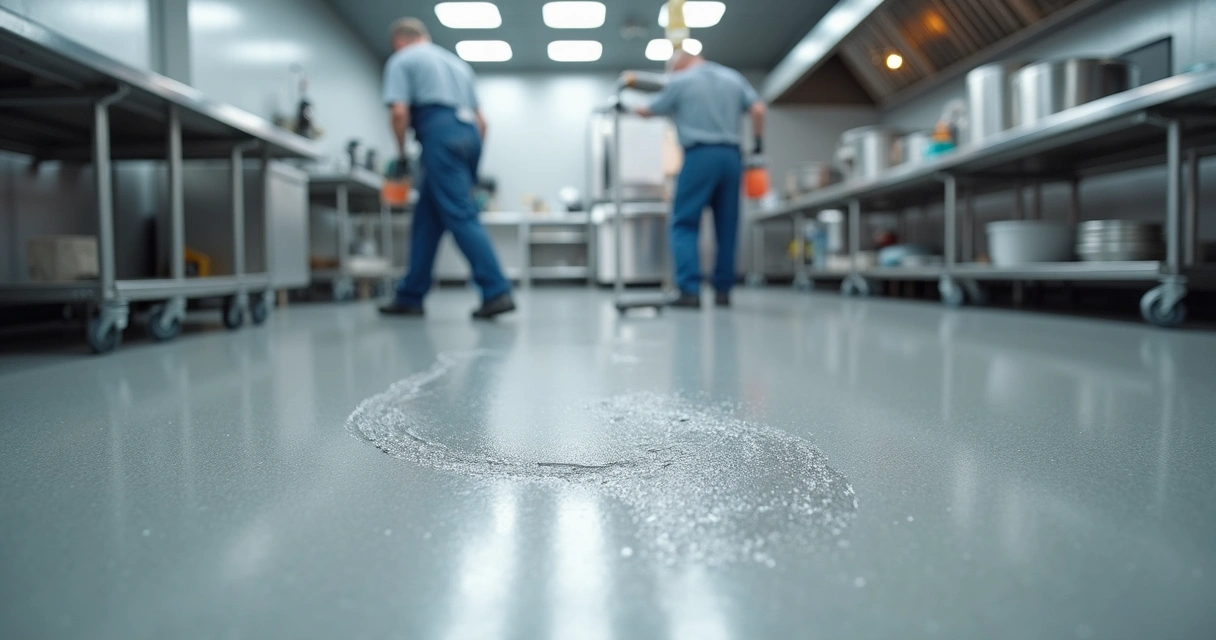
The sanitation rules every commercial kitchen must follow
Florida commercial kitchens must meet very specific hygiene standards laid out by agencies such as the Florida Department of Business and Professional Regulation, the Department of Health, and local authorities. These rules are enforced through regular inspections. Floors play a major role in passing these audits.
What do the food codes and ADA require?
Current Food Code (based on FDA and state guidance) requires that:
- Kitchens have floors that are smooth, durable, non-absorbent, and easy to clean in all food prep, storage, dishwashing, and walk-in refrigerator/freezer areas.
- Floors be free from cracks, open joints, or gaps that allow for accumulation of dirt and water.
- Mats and rugs be cleanable or removable—loose coverings are not a substitute for proper floor installation.
- Surfaces be light-colored enough to show buildup of debris or grime for prompt cleanup.
- Slope-to-drain is required where water runoff occurs, preventing pooling (especially near sinks and dish stations).
- Slip hazards are mitigated (see OSHA and ADA requirements for footwear areas and thresholds).
Epoxy meets or exceeds these conditions when installed correctly. Our team at GCM Best Services always reviews updated Florida building codes and health standards on each project, so our clients pass inspections with confidence.
How epoxy helps you stay compliant—and avoid penalties
Sanitation law is clear; violations can shut down a kitchen or result in hefty fines. With epoxy, several advantages keep your business in the clear:
- Impermeable barrier: Epoxy creates a barrier immune to absorption, so pollutants, grease, or liquids can’t seep beneath.
- Continuous coverage: Its seamless application removes grout lines, tile seams, and old cracks where moisture would linger and bacteria could breed.
- Resistant to mold and pests: Floors that are easy to keep dry don’t attract pests or allow black mold to grow.
- Withstands rigorous cleaning: Frequent mopping, power washing, and use of disinfectants won’t erode the finish or open up pores.
- Inspection-friendly: Clean, uniform surfaces are faster to check and maintain. No hidden flaws for inspectors to uncover.
- Custom features: Coving (floor-to-wall curves), tactile markers, or footholds near drains improve accessibility and meet ADA rules.
In our experience, investing in proper epoxy installation prevents service interruptions and sends a signal to health officials that your business takes safety seriously.
Safety rules: Where epoxy goes beyond just clean floors
Sanitation is one side of the coin. Safety for both staff and guests is the other. Slippery surfaces, hot spills, abrupt level changes, and cracked flooring can cause major injuries. In kitchens, these risks multiply under time stress and crowded conditions.
Reliable slip resistance
The right epoxy system helps you:
- Texture surface grip: Broadcast flakes, quartz, or sand give traction. Even when floors are greasy or wet, risk of falls is reduced.
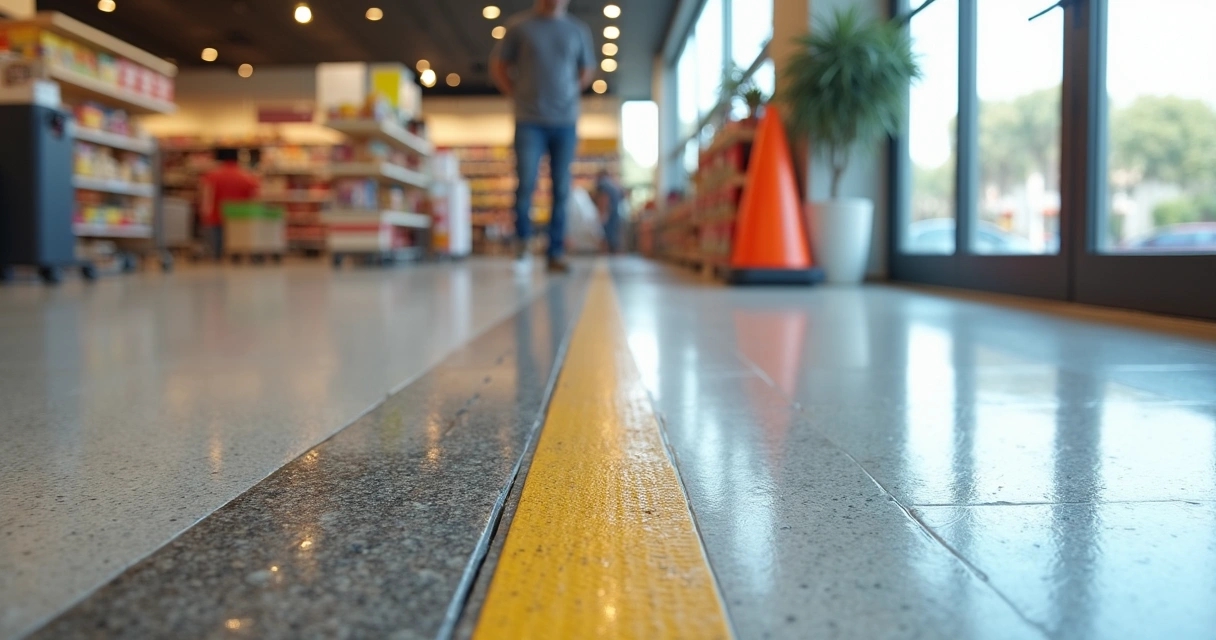
- Defined zones: Visual markers can color-code “hot,” “clean,” and “safe path” areas. This helps staff and supports health survey documentation.
- Tolerance to heat and spills: Epoxy withstands splashed oil, dropped pots, and temperature swings, avoiding melted or warped sections that trip staff.
- No edge hazards: Integrated coves or slope transitions eliminate trip points at thresholds, drains, or doorways.
Floor safety supports every step in your kitchen’s workflow.
Meeting OSHA and ADA standards
We regularly check our installations against:
- OSHA 29 CFR 1910.22: “All places of employment should be kept clean, orderly, and in a sanitary condition. The floor…shall be kept free from hazards likely to cause slips, trips, or falls.”
- ADA Accessibility Guidelines: Specifies maximum changes in level, slip resistance (coefficient of friction), and transition requirements for kitchen and serving areas.
GCM Best Services adheres to these standards, and we offer a variety of slip-resistant additive options, even calibrating the finish for shoes, kitchen carts, or cleaning equipment used in your space.
How we install epoxy floors for commercial kitchens
Achieving health-code compliance and performance depends on the right materials and process—not just a coat of paint! Here’s how we ensure results that stand up to commercial use.
Professional moisture and surface evaluation
Before work starts, we conduct moisture readings and hardness tests on the substrate. This is a step many underestimate, but it is absolutely necessary. If moisture or pH levels are too high, the coating can bubble, peel, or fail—invalidating the protection you paid for.
Precise surface preparation
We use diamond grinding or shot blasting, not simple acid etching. This roughens the concrete to a consistent profile that the epoxy will grip tightly.
- Crack repair and patching: All chips, divots, bugholes, or cracks are filled and sanded smooth. This prevents flaws showing through or becoming future problem spots.
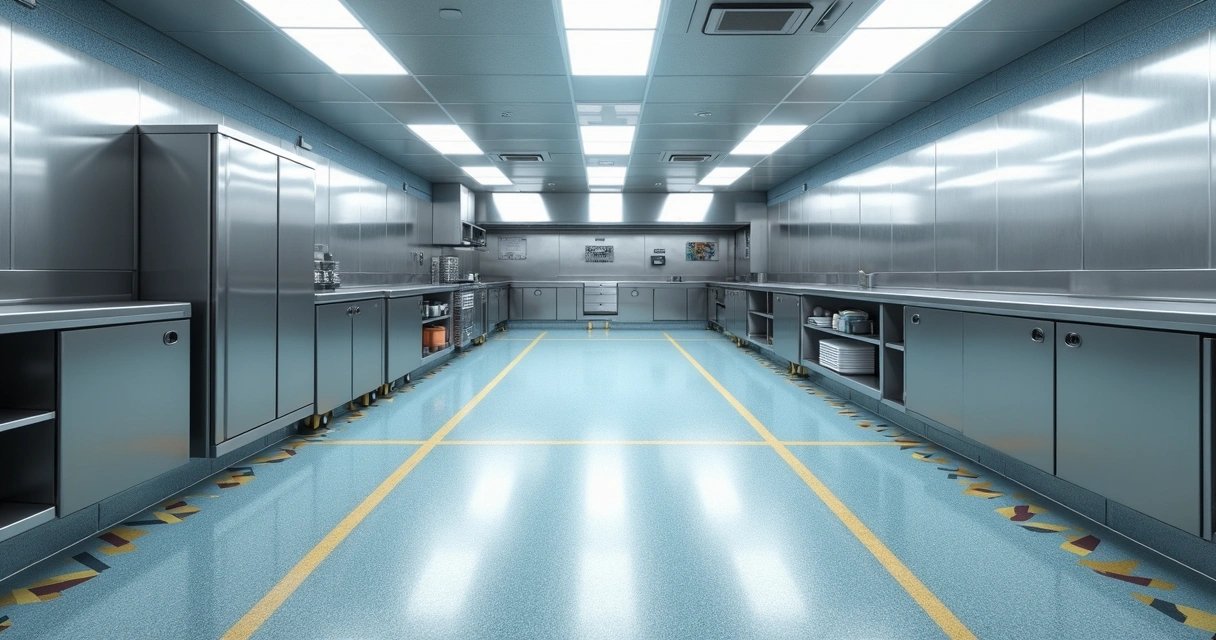
Material selection and system build-up
For most kitchens, we recommend 100% solids epoxy with polyaspartic or polyurethane topcoats for high chemical, thermal, and scratch resistance. Specifics vary by space:
- Single or multi-coat build (3–6+ millimeter thickness)
- Texture or broadcast options (flakes, quartz, silica sand, etc.)
- Integral color or light-reflective pigments
- Cove base and slope-to-drain integration
- Fast-curing formulas for minimal kitchen disruption
Professional installation and curing
We apply layers in strict sequence, using squeegees and backrollers for consistent thickness and to remove bubbles. Between coats, surfaces are checked for adhesion and smoothness. The kitchen can usually return to operation after 12–24 hours, though this varies based on system and temperature.
Cleaning and maintaining epoxy kitchen floors
Epoxy floors deliver their best performance when maintained properly. Good news: these floors are among the easiest to keep clean and sanitary in demanding environments.
- Daily cleaning: Mop or auto-scrub with neutral cleaners. Avoid harsh abrasives, which aren’t needed with a non-porous finish.
- Immediate spill response: Wipe up oil, acid, or strong chemicals to prevent staining.
- Periodic sanitizer: Disinfectant mops or broad-spectrum antimicrobials work well on seamless epoxy.
- Regular inspection: Look for chips, scratches, or dull areas—early repairs save money later.
- Annual or semi-annual recoating: Polyaspartic topcoats can be refreshed to keep slip resistance at its best.
With proper maintenance, epoxy floors deliver a multi-year service life. If you’re curious about common surface problems and solutions, see our deeper coverage in topics like concrete repair for commercial spaces and crack prevention techniques.
Epoxy, concrete, and the kitchen environment: Getting the substrate right
Epoxy can only perform well on a sound base. A kitchen’s subfloor may be old concrete, newer slabs, or a patchwork of materials after remodels. At GCM Best Services, we diagnose problems such as:
- Poorly compacted or shifting bases (more common in Florida’s sandy soils)
- Drainage failures leading to standing water under or around slabs
- Cracks or weak joints from prior repairs
We address these as part of our prep, which sometimes involves full slab replacement or slope reconstruction. If you want to learn more about the process of site prep, compaction, and drainage for a solid commercial foundation, our concrete services section goes in-depth on these steps.
What to expect during permits, HOA, and inspection stage
In Central Florida, most commercial kitchen flooring upgrades require city permits and plan review. Some food service operations operate within HOA-governed properties and must provide product and workmanship details for approval.
At GCM Best Services, we:
- Prepare submittals specifying product data sheets, slip test ratings, and MSDS for health department review
- Coordinate with inspectors on both pre-install and punch-list walkthroughs
- Document project completion with before/after photographs (useful for both code compliance and insurance)
- Back every floor with a written warranty and a user-friendly maintenance guide
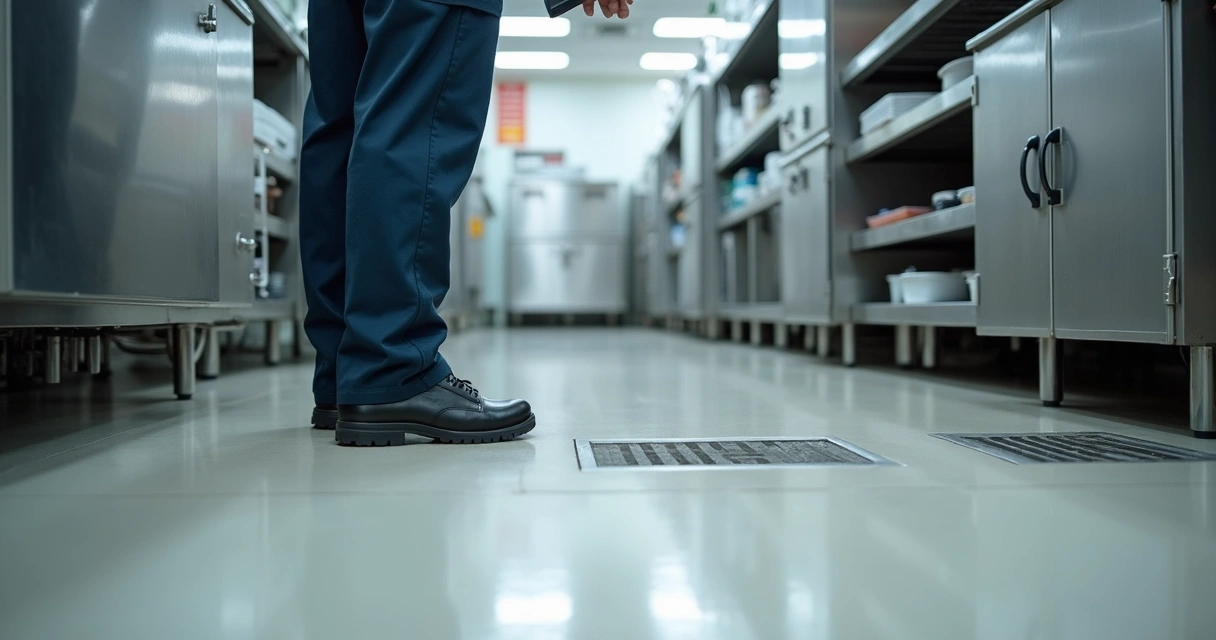
The connection with other kitchen surfaces and exterior systems
While floors do most of the heavy lifting for kitchen hygiene, their durability and compliance are also affected by:
- Wall prep and coating (for splash zones, dish areas, and prep lines)
- Transition to other flooring types (like pavers in outdoor service areas or concrete patios)
- Entry thresholds and screen enclosures that limit pests and debris
For facilities with outdoor prep or service zones, blending epoxy with durable hardscaping ensures workflow continuity. If you’re looking to extend safety and cleanability outside, our advice on hardscaping and paver installation applies. And yes—we’re often asked about weed growth or transition maintenance. Our guide to preventing weeds in pavers offers useful tips for restaurant patios and entryways.
Design, aesthetics, and function: Epoxy’s modern options
Epoxy is far from bland. For kitchens visible to guests (chefs’ counters, front-of-house exhibition lines) or open-concept hospitality spaces, owners now request options like:
- Colored quartz blends that reflect branding or zone usage
- Exposed aggregate looks or metallic pigments for wow effect
- Safety striping and clear zone demarcations
- Inlaid logos or decorative motifs
All these enhancements preserve cleaning, safety, and compliance benefits. For areas connecting to customer spaces, designers often combine epoxy with specialty concrete or brick and paver accents to coordinate the kitchen’s hidden functionality with outdoor dining environments.
Warranty, aftercare, and long-term service
A comprehensive epoxy installation should always be backed by a written warranty—not just a verbal promise. Our process at GCM Best Services finishes with a walk-through, a documented warranty (covering delamination, staining, and finish defects), and a simple how-to guide for daily and periodic cleaning tasks.
If you need repairs in the future—a chipped corner, a worn entry ramp, or a section that needs texturing for changed workflow—don’t ignore them. A minor fix is inexpensive and keeps your kitchen in full compliance.
Conclusion: Kitchen flooring built for health, safety, and peace of mind
Epoxy offers more than just a fresh look for commercial kitchens in Orlando and Central Florida. Its real value is the way it fortifies your hygiene strategy, keeps staff and visitors protected, and supports regulatory success. From the way we specify products, perform site prep, and manage code compliance, every step serves to make your kitchen safer, cleaner, and built for the long haul.
If you want expert guidance on the right epoxy system—or a full assessment of your kitchen surfaces—we’d love to help you create a smoothly run, compliant kitchen that passes inspections with ease.
Contact GCM Best Services today, and let’s build a safer, stronger foundation together.
Frequently asked questions about epoxy flooring for commercial kitchens
What is epoxy flooring for kitchens?
Epoxy flooring for kitchens is a specialized, seamless surface made from a two-part resin system (epoxy and hardener) that is installed over concrete, creating a durable, non-porous, and hygienic floor covering. This type of flooring is ideal for busy commercial kitchens because it resists stains, chemicals, and heavy impact while supporting daily cleaning routines and sanitary standards.
How does epoxy improve kitchen safety?
Epoxy improves kitchen safety by providing a slip-resistant, seamless, and durable floor that reduces the risk of slips, trips, and falls. With custom textures and slope-to-drain options, it manages spills better than traditional flooring, lessens surface imperfections, and helps identify different kitchen zones for safe movement and workflow.
Is epoxy flooring easy to clean?
Yes, epoxy flooring is very easy to clean because it is non-porous, seamless, and resists the buildup of grease, dirt, and bacteria. Daily mopping or use of floor scrubbers removes contaminants easily, and the floor’s chemical resistance allows for frequent disinfecting without damage.
How much does epoxy flooring cost?
The cost of epoxy flooring in commercial kitchens depends on the room’s size, existing floor condition, chosen finishes, and any custom features such as coves or safety striping. On average, prices range from $7 to $15 per square foot for professional, code-compliant installations in Central Florida. Site prep, moisture mitigation, and premium finishes can influence total investment.
Does epoxy meet health regulations?
Properly installed epoxy flooring meets or exceeds health regulations for commercial kitchens as set by FDA, state food codes, and local agencies. It is smooth, durable, non-absorbent, and easy to clean—key criteria for passing sanitation inspections and operating a safe food service environment.